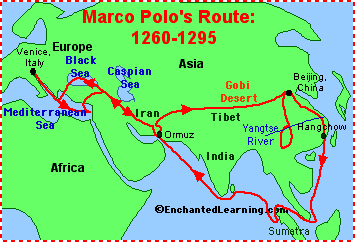
Marco Polo brought back with him many things previously unseen by Europeans during that time. Polo brought back a new technology to the West--a unique navigation device that was first developed by the Chinese--the compass. With a compass at hand, the world of navigation and exploration would change for the Europeans, as they were now able to navigate both land and sea more easily and efficiently. This also was a stepping stone for topography and map making. Maps would be more accurate, and give a universal direction for navigation with respect to a compass. In addition to technology, Marco Polo brought back with him paper, paper currency, porcelain, raw silk, ivory, jade, spices, and noodles. Among the most significant of these items was paper. With these new items, the Europeans were then able to, hundreds of years later, develop an effective printing press, in which mass prints were able to be produced. A common misconception is that Marco Polo brought back with him tea. Marco Polo, in fact, did not bring tea back with him from his expedition. Tea was only brought back to Europe much later. This probably arose because of Marco Polo's association with the Silk Road. Marco Polo was among one of the firsts to travel across the Silk Road, and tea was acquired via the Silk Road, so putting the two together, many would conclude this.
The Mongols introduced to Marco Polo a very new and intriguing concept--paper currency. He thought this was a very surprising. How could you substitute essentially worthless paper for gold and silver? However, seeing how it effectively worked, Marco Polo said : "With these pieces of paper they can buy anything and pay for anything. And I can tell you that the papers that reckon as ten bezants do not weight one." (Silkroad Foundation). The idea of paper currency arose to lessen the burden of traveling merchants carrying clunky gold and silver coins everywhere they went, making traveling for the merchants much more easy and efficient.
Before Marco Polo's travels, Europe believed they were the most prosperous society in the world. This was a premature thought though, for they did not even know of the existence of China and the Mongol Empire, which were much more complex societies than Europe was. Some places in China and the Mongol Empire even had indoor plumbing and the successful economic usage of paper money was utilized in society. This made sparked a fire in the Europeans--igniting a desire to advance more and more. The fire was so much that the Europeans would eventually take over China in terms of advancement during Europe's industrial revolution in the 18th and 19th centuries.
Europe was not the only one that positively affected by Marco Polo's travels. Unsurprisingly, China, too, was affected in a positive manner. Marco Polo had introduced gunpowder to the Chinese. With this, the Chinese were able to utilize gunpowder to make not only fireworks, but military arms too. They were able to develop their military weapons from steel weapons and hand-combat weapons to more advanced arms. They were able to make ammunitions like fire lances, but more importantly, the Chinese were able to develop the rocket. Without the Chinese's invention of multi-staged rockets, it is possible that the future development of the space shuttle would not have occurred.